
There is a special place in my heart for the novel.
Much of my life was influenced by reading. As a child, I would often find an obscure hiding spot in my home where I would sit and read a good book.
My elementary school’s librarian (Mrs. Z) was an eccentric older woman with long, wild grey hair and small rectangular glasses, who believed in carrying a variety of books for young readers – especially the criticized and controversial, as long as the school would allow. When the principal called for the removal of a particularly gory sci-fi series, Mrs. Z sneakily allowed me to check out the remainder of the books from behind the counter. I had already read the first few books, after all.
(Reader, I wish I could remember the name of this series! If I do at some point, I will update this post.)
Our small town’s local library was located in our community center. After an evening of tap and jazz dance class, I would stop at the library and see what was new in stock. I once checked out a book where the protagonist assigned animal personas to the people in her life, that were dependent on their style or personality. I saw my dance teacher as a monkey; my dad was a grizzly bear.
To pass the time, I would try to recreate my favourite book covers with pencil-crayons and paints.
The Hollow Tree was a favourite of mine in grade five – my teacher challenged me to draw the cover as book mark.
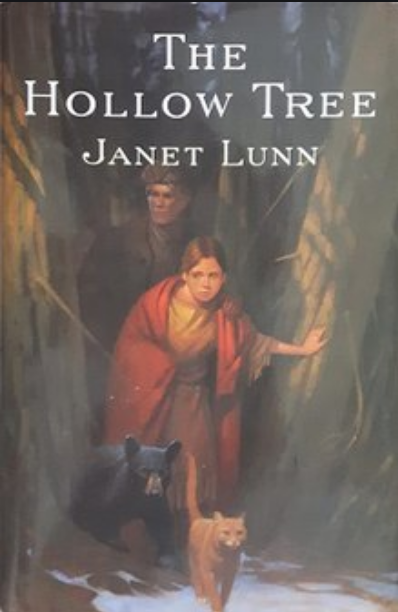
written by Janet Lunn.
To be sure, the novel is a special kind of art. What I love about novels (fiction, in particular) is their vitality. The novel is a package of life itself that contains bits of the world and the collective human experience, but which only comes alive in the reader’s hands.
.
In its bones – character, setting, plot – the novel embodies the collective human experience. A believable story, even one made from dragons and fairies, contains elements of shared human truth. Regardless of our different walks of life, we all recognize laughter, friendship, terror, cleverness, betrayal… To read a book is to consume elements of our shared ancestral experiences of what it means to be human. The writer creates the overall story from these experiences.
In doing so, the writer gives pieces of themselves to the narrative. Each piece of writing contains truths from the author’s life. It may be that the pasture which the damsel runs through while escaping thieving bandits is the very same pasture that the author once picked dandelion heads.
Or, the fighting government parties that are creating social tension and whispers of civil war are the same politicians from the author’s home country.
Maybe, the protagonist’s deep and unforgiving grief they find themselves drowning in after their spouse’s death is the same grief the author swam through after the death of their mother.
Of course, the details will change, but the writer’s experiences will always find themselves immortalized in the novel.
Yet, what I find so fantastic about the novel is how it comes to life only in the reader’s hands. On its own, the novel is just a collection of words, a stack of paper collecting dust on a forgotten shelf. But, in the hands of a reader, the novel springs to life. In this sense, I often refer to the novel as a spell and the reader as a spell weaver. To be sure, I am not the first to feel this way.
Novels are truly an art of magic. They exist as a world in and of themselves: a world within a world. They contain the collective human experience and immortalize facets of its writer.
The best novels invite you to become lost within them, fall in love with their characters, and identify with their settings. They will stick with you long after you have turned the final page.
